
City Data Collection and Storage
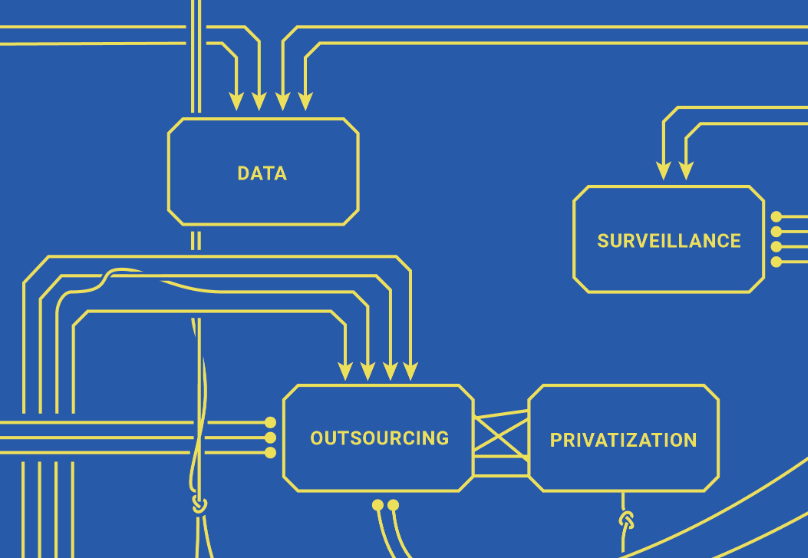
We investigate how emerging technologies often introduced without democratic debate may further weaken democracy, such as mobile driver’s licenses, digital wallets, and centralized benefits distribution portals. We center sites such as schools and health care.
Digital ID and Wallet Systems

Digital ID systems are quietly and rapidly remaking how identification documents like drivers licenses function in the United States and around the world. Digital ID systems are promoted by corporate vendors and governments as convenient ways to electronically verify identity, age, education, insurance, travel, health, and payment information. Governments are increasingly using Digital ID systems to sign people up for social services, utility assistance, tax refunds, opening bank accounts, buying products online or accessing age-restricted content. In places that have already adopted Digital ID systems, increased surveillance and exclusion from government services have been documented
- NEW REPORT! Digital ID or Democracy? An Advocate’s Introduction to the Tech, Politics, and Urgent Demands Needed to Protect Human Dignity
- Navigating Your State’s Digital ID System
- Updated Spreadsheet of State Digital ID Systems
- Demands for Protecting Human Dignity and Choice from Digital Identification Systems
- Digital ID Systems Movie Night Toolkit
- Understanding the Risks of Digital IDs FAQ
- Mobile Driver’s Licenses and the Costs To Privacy, Safety, and Security
Ed Tech and AI
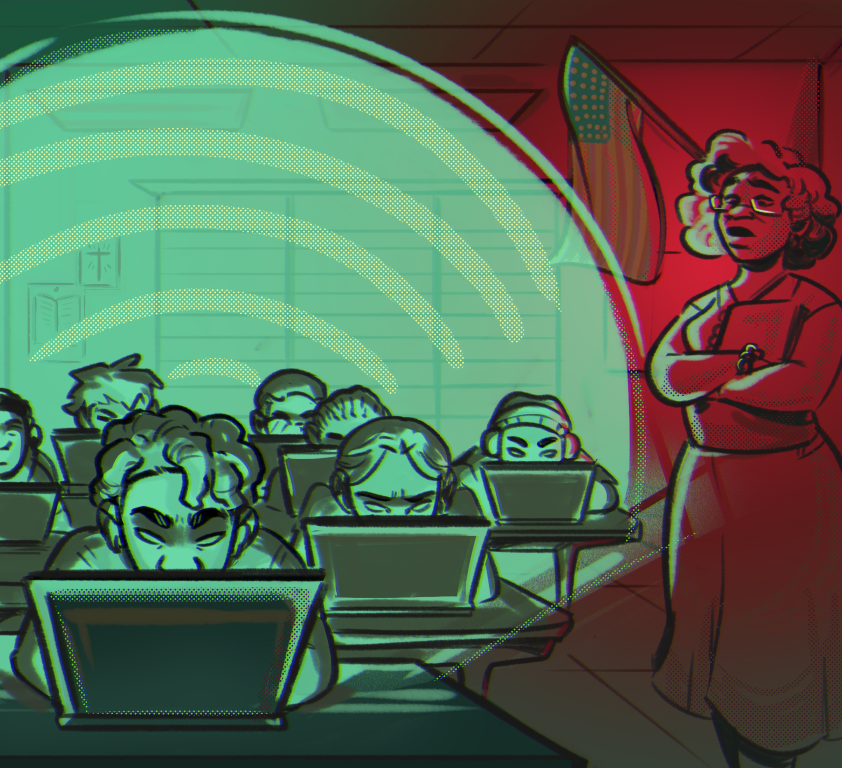
We support organizers with research analyzing educational technology (ed tech)—an industry made up of vendors, philanthropic foundations, and financial interests—seeking to transform public education into a growth market for scalable digital solutions. While an unprecedented amount of student information is being processed and opaquely shared through ed tech’s data pipelines, these products are most often adopted by schools without input or consent from key stakeholders—teachers, students, and parents. We work in coalition with parent and teacher advocates seeking democratic alternatives to commercial solutions for public education, and take an on the ground approach to envisioning what the future of schools, public goods, and democracy can be.
Through the advent of cloud computing, algorithmic tools, and AI-enabled products, educational software vendors and privatizers have sought influence over curriculum design, student diagnostics, and teachers’ professional development. The adoption of these technologies in the face of deteriorating privacy protections and cuts in public funding has a profound potential to shape the nature of teaching and learning, exposure to surveillance in schools, as well as the future of work.
Resources developed in collaboration with teachers:
External resources developed with our research:
CRCR Coverage and Media

Read more about the work CRCR’s collaborators are doing to disrupt entrenched narratives, and the media coverage of the research we are helping to produce
- Media coverage: Tech oligarchs are helping DHS set up authoritarian surveillance state, report says, by Maurizio Guerrero in Prism, July 7, 2026.
- Narrative strategy: Forever Followed by ICE, by Bárbara Paes in The Border Chronicle, June 25, 2026.
- Media coverage: New Report Highlights Growing Partnership Between Surveillance Tech and ICE, by Shireen Akram-Boshar in TruthOut, June 25, 2026.
- Media coverage: We should be worried: report sheds light on ICE’s booming arsenal of high-tech tools, by Sanya Mansoor in The Guardian, June 24, 2026.
- Narrative strategy: Tech, War and the Everywhere Border, by Mizue Aizeki in The Border Chronicle, June 4, 2026.
- Media coverage: New York City’s Multibillion-Dollar Black Box Contracts Face Scrutiny by Nick Garber and Zachary Groz in New York Focus, May 6, 2026.
- Media coverage: Policy change allows NYC to fund pilot programs with little oversight, per lawsuit by Ben Feuerherd in Gothamist, April 6, 2026.
- Media coverage: The facial recognition grocery fight by Alfred Ng in Politico, March 16, 2026.
- Media coverage: Ex-NYPD official’s indictment prompts calls for review of Adams-era contracts by Ben Feuerherd in Gothamist, February 20, 2026.
- Media coverage: We must fight age verification with all we have, by Taylor Lorenz in User Mag, August 25, 2025.
- Narrative strategy: Digital IDs Put Health Care Privacy at Risk by Cynthia Conti-Cook, Rebecca Williams and Sawyeh Esmaili in Convergence, August 4, 2025.
- Media coverage: How Eric Adams’s MyCity Portal Became a $100 Million Question Mark by Zachary Groz in New York Focus, March 19, 2025.
- Media coverage: Costs pile up for Adams’ MyCity site amid outsourced work by Nick Garber in Crains New York, February 1, 2024.
NYC Hearings 2024-2026
Learn more about CRCR’s Testimonies.
Committee on Contracts Oversight – Transparency and Accountability in the City’s Use of Master Agreements on June 17, 2026
Hearing Details:
- Venue: New York City Council (at New York City Hall)
- Date: June 17, 2026
- Committee Host: Committee on Contracts
- Chair: Lincoln Restler
Context: This hearing, following a report by the NYC Comptroller on the same topic, discussed concerns about transparency, waste, and oversight by the public and other government agencies of purchases made pursuant to Master Agreements.
CRCR’s testimony urged the Committee on Contracts to expand public reporting, transparency, oversight and public participation in the procurement process of technology to create meaningful transparency and accountability in a process that is increasingly dominated by corporate values of secrecy, competition, and serving shareholders’ interest above the public interest.
Committee on Technology Oversight Hearing on Facial Recognition Technology and the Collection of Biometric Data on March 2, 2026
Hearing Details:
- Venue: New York City Council (at New York City Hall)
- Date: March 2, 2026
- Committee Host: Committee on Technology
- Chair: Carmen De La Rosa
Context: This hearing discussed facial recognition and biometric collection technology in public accommodations and multi-unit housing.
CRCR’s testimony outlined the ongoing and foreseeable harms associated with biometric collection and recognition technologies and the history of New Yorkers fighting for their privacy against increased surveillance.
Committee on Contracts Hearing on Emergency Procurement Policies on January 27, 2026
Hearing Details:
- Venue: New York City Council (at New York City Hall)
- Date: January 27, 2026
- Committee Host: Committee on Contracts
- Chair: Lincoln Restler
Context: This hearing discussed issues related to emergency procurement.
CRCR’s testimony emphasized how, similar to emergency procurement and how it reduces public transparency, access to justice, fair competition, democratic engagement and accountability mechanisms, so do Master Agreements and overuse of pilot project procurement. This enables corruption and burdens New Yorkers with low quality public services. Testimony emphasized how technology procured through Master Agreements grant technology vendors asymmetrical power over governance by designing and defining the terms, diminishing New Yorkers’ democratic power. CRCR recommends that the Committee on Contracts investigate New York City Master Agreements and revise its policies on their use for procurement.
Committee on Technology and Committee on Civil and Human Rights Oversight Hearing on Privacy Protection in the Digital Age: Balancing Technological Advancements with Privacy Protections on December 8, 2025
Hearing Details:
- Venue: New York City Council (at New York City Hall)
- Date: December 8, 2025
- Committee Hosts: Committee on Technology and Committee on Civil and Human Rights
- Chairs: Jennifer Gutiérrez, Chair of the Committee on Technology; Nantasha M. Williams, Chair of the Committee on Civil and Human Rights
Context: This hearing discussed the weakening privacy protections associated with the proliferation of emerging technologies.
CRCR’s testimony outlined the recent developments in data sharing, privacy protocols, and pending state legislation (the One City Act) pushed by the Adams administration that would jeopardize New Yorkers’ privacy and undermine Identifying Information Local Laws 245 and 247 which created an expectation that personal identifying information collected for the purposes of accessing city services would be protected by agency privacy officers from suspicion-less seizure and corporate sale. CRCR made the following recommendations:
Committee on Technology and Committee on Civil Service and Labor Hearing on Algorithmic Tools and their Effects on City Employees on June 26, 2025
Hearing Details:
- Venue: New York City Council (at New York City Hall)
- Date: June 26, 2025
- Committees Host: Committee on Technology; Committee on Civil Service and Labor
- Chairs: Jennifer Gutiérrez, Chair of the Committee on Technology; Carmen De La Rosa, Chair of the Committee on Civil Service and Labor
Context: Intro 1066 (enacted January 17, 2026) was a bill introduced into the New York City Council by Councilmember Nantasha Williams in September of 2024. A joint hearing about the bill was held in June of 2025 by the City Council Committees on Technology and Civil Service and Labor. Intro 1066 requires the Mayor’s Office of Technology and Innovation (“OTI”) to study the impact that algorithmic tools are having on the hiring and work habits of city employees.
CRCR’s testimony focused on expanding the scope of the study commissioned by Intro 1066 to better capture the wide-ranging and interconnected areas that will affect workers through the contracting and use of algorithmic tools.
Committee on Public Safety, Committee on Technology, and Committee on Oversight & Investigations Hearing on Oversight and Legislation: Examining NYPD’s Implementation of the POST Act on February 19, 2025
Hearing Details:
- Venue: New York City Council (at New York City Hall)
- Date: February 19, 2025
- Committee Hosts: Committee on Public Safety, Committee on Technology, and the Committee on Oversight & Investigations
- Chairs: Yusef Salaam, Chair of the Committee on Public Safety; Jennifer Gutiérrez, Chair of the Committee on Technology; Gale A. Brewer, Chair of the Committee on Oversight & Investigations
Context: The Public Oversight of Surveillance Technology (POST) Act was enacted by City Council in 2020 and requires the New York City Police Department (NYPD) to evaluate and report on surveillance technologies used by the Department. This legislation would add new provisions to the law which would require that the NYPD, upon request, provide the Department of Investigation (DOI) with an itemized list of all surveillance technologies currently used by the Department, and provide information on all data access and retention policies for data collected by such technologies. In addition, the legislation requires that the NYPD provide DOI with semiannual updates on all newly acquired or discontinued surveillance technologies and updates to any data access and retention policies established in recently executed contracts for surveillance technologies.
CRCR’s testimony, also presented on behalf of the Street Vendor Project, an advocacy group that champions the rights of street vendors as small businesses to earn a living and contribute to the culture and life of New York City. The testimony focused on the specific impact of NYPD surveillance on the livelihoods of street vendors, many of whom are immigrants. The testimony also focused on the impact of data sharing practices between the NYPD and different agencies that work to expand surveillance and target vulnerable populations, including the immigrant community. CRCR testified that the POST Act must include data-sharing technologies that implicate other agencies because of their use as surveillance technologies by the NYPD. Beyond just data sharing, these cross-agency collaborations also allow the NYPD to significantly expand their police force by allowing them to control a large number of civilian agency officers. However, these peace officers avoid the accountability and oversight mechanisms that the NYPD are beholden to, such as the Civilian Complaints Review Board, extends only to the NYPD. In addition, the requirement for data reporting must include initiatives like Community Link, but also technologies adopted by New York public schools, benefits portals like MyCity, the sanitation Trash Dash, and citywide data sharing systems like Worker Connect.
Committee on Technology Oversight Hearing on the Use of Automated Decision Systems and Artificial Intelligence on October 28, 2024
Hearing Details:
- Venue: New York City Council (at New York City Hall)
- Date: October 28, 2024
- Committee Host: Committee on Technology
- Chair: Jennifer Gutiérrez
Context: The Office of Technology and Innovation (OTI) testified regarding Local Law 35, under which City agencies are required to report annually on their use of algorithmic tools. The purpose of the reporting process is to provide transparency on AI and related tools with material public impact. Also discussed were bills 0199, 0926, and 1024 (in relation to establishing an office of algorithmic data integrity; in relation to the creation of appropriate and responsible use practices for artificial intelligence tools used by city agencies; and in relation to requiring a centralized list of artificial intelligence tools approved to be used by city agencies, respectively). OTI testified against these bills, citing their AI Action Plan (which, as of October 16, 2025, is still underway, but the main deliverables have primarily been updating policy documents), and noting that the initiatives proposed by the bills would conflict with their existing initiatives.
CRCR’s testimony focused on the general need for increased oversight into the City’s technology procurement process. Further, the testimony focused on the need to disentangle corporate interests from government oversight, citing directly to the failures of the MyCity chatbots and the inability of the public to understand what training data resulted in illegal advice and what the failed chatbot cost the city. Testimony also emphasized how key technological concerns that are relevant for City Council to consider now include the MyCity chatbot and Master Service Agreement contracts (MSAs). The former is an example of an egregious failure by the City due to the failure of the vendor to comply with mandatory reporting requirements, and OTI testimony highlights gaps in the procurement process because of the agency’s ability to hide behind contracting obligations to avoid responsibility and transparency. The latter is an example of another anti-democratic aspect of the procurement process. MSAs allow agencies and vendors to hide behind massive, complex, and opaque contracts that hide the cost of their services. MSAs also invite non-competitive procurement processes that pave the way for sole-source vendors to take advantage of the city, and make the public vulnerable to more asymmetrical power dynamics, the kind that contributed to the failures of the MyCity chatbot.
Committee on Technology Oversight Hearing on the MyCity Portal Project on September 30, 2024
Hearing Details:
- Venue: New York City Council (at New York City Hall)
- Date: September 30, 2024
- Committee Host: Committee on Technology
- Chair: Jennifer Gutiérrez
Context: Originally pitched during the first election campaign of disgraced former mayor Eric Adams, MyCity is a digital platform app that was marketed as “a one-stop shop for New York City services and benefits.” During Adams’s tenure as mayor, MyCity became a source of endless controversy and government abuse. Contrary to his campaign promises, it was outsourced to private tech corporations with no democratic oversight or input, lacked adequate data privacy safeguards, became mired in lengthy delays, and ended up disastrously over budget, costing the city at least $100 million in taxpayer dollars. To boot, MyCity failed to deliver on its core promise: providing a single hub from which New Yorkers could access their benefits. As of 2026, MyCity’s capacity remains woefully incomplete even as it has funneled enormous amounts of personal data (and money) to private corporations and the police department. As a result of the scandals arising from the development of MyCity, the New York City Council Committee held an oversight hearing in September of 2024. The hearing also addressed Intro 821, a bill which would have made the development of the MyCity app required by law.
CRCR’s testimony, presented along with a half dozen other organizations we briefed on MyCity, highlighted the connections between policing by the NYPD, the financial interests of private tech corporations, the abuse of city contracting processes, and the development of MyCity to extract and centralize personal information. In particular, CRCR exposed three key features of the MyCity project: (1) MyCity is the result of decades of expansion of police influence throughout city government. The project was based on prior technologies like NYPD’s CompStat, Worker Connect and has the potential to be used to increase police access to private personal information for the purposes of defending uses of force while aggressively policing city rules and regulations. (2) MyCity’s data extraction is made possible through outsourcing development to predatory corporate technology vendors that have a history of selling personal information for profit. Because of faults in city contracting processes, technology corporations are able to secure lucrative contracts on taxpayers’ dimes without any democratic oversight or accountability.
Procurement Policy Board Public Meeting on Multi-Award Reform, Challenge-Based Procurement, Electronic Bidding, and Resolution to Adopt Administrative Procedures on August 28, 2024
Hearing Details:
- Venue: New York City’s Mayor’s Office of Contract Services
- Date: August 28, 2024
- Host: Procurement Policy Board
Context: The Procurement Policy Board (PPB) held a public meeting on proposed rule changes impacting demonstration projects including: (1) expanding the scope of what agencies can use the demonstration project process for; (2) expanding the scope of what agencies can use the demonstration project process for; (3) extend how many years agencies can take to evaluate a demonstration project; (4) allow agencies to engage a demonstration process without any intention to hold a competitive bid process; (5) and add language encouraging agencies to use challenge-based procurement for demonstration projects.
CRCR’s testimony cautioned against the proposed expansion of the scope of demonstration projects without meaningful oversight. Our testimony highlighted the harms associated with increasing procurement efficiency at the expense of design and impact assessment, namely how rolling back the guardrails to speed up the procurement process for demonstration projects will threaten civil rights, New Yorkers’ data, New Yorkers’ digital autonomy, and democratic power. The City must operate with the same understanding as consumers when it is procuring technology: they are giving companies access to a precious resource–New Yorkers’ data–and a company’s intention behind proposing a demonstration project may not always be becoming a vendor. They may want access to the data for development of another type of tool outside the scope of their demonstration project. Loosening demonstration project rules would make New Yorkers’ data vulnerable to tech vendors seeking access to their data to capture public sector markets, to the use of their data for purposes outside the scope of their proposed demonstration, or to vendors hoping to backchannel the piloting of their services to avoid public scrutiny. Therefore, instead of streamlining the procurement process for demonstration projects, the City should prioritize developing a more thorough, democratic procurement process that protects New Yorkers and their data from being a sandbox for untested technologies.