
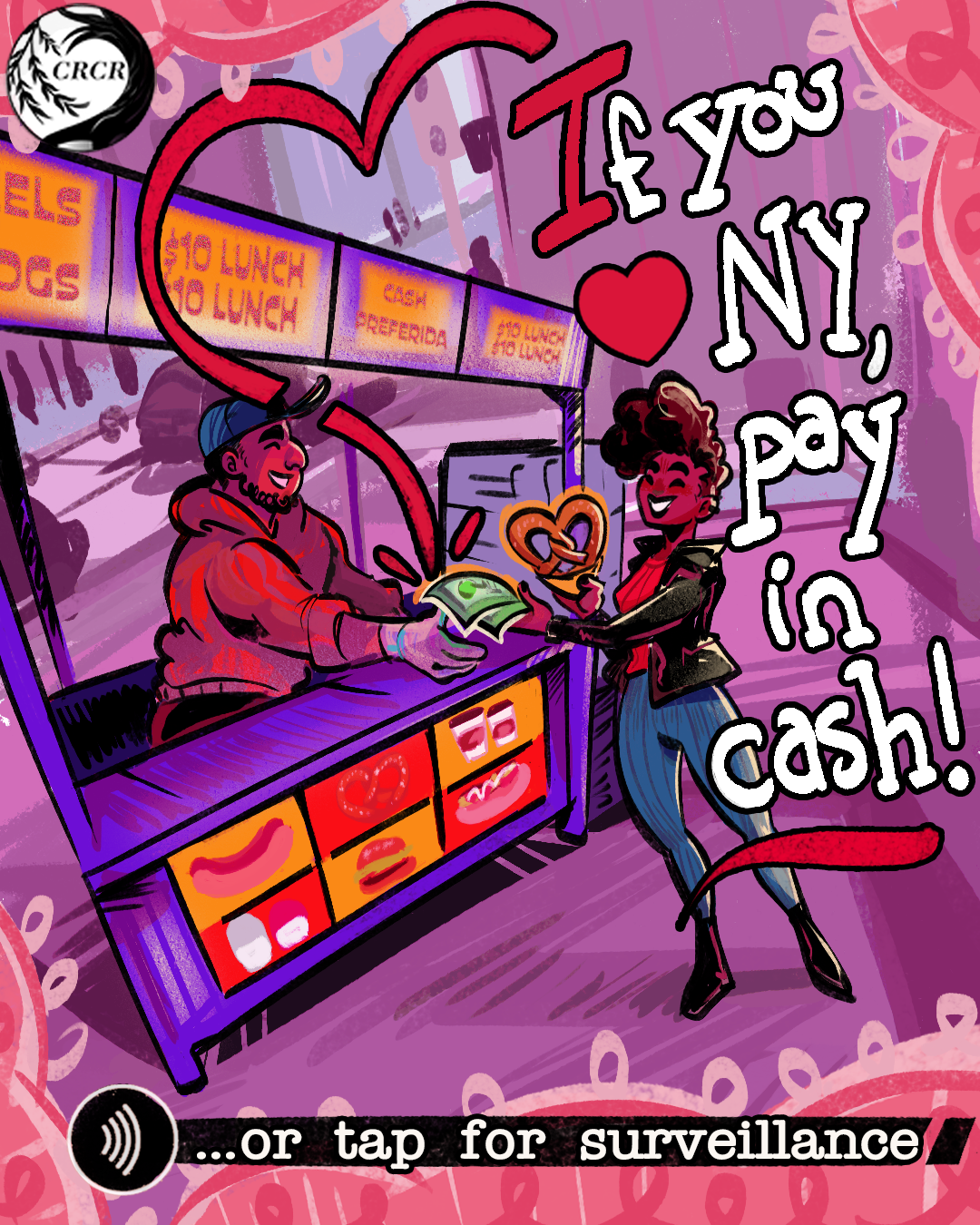
IF YOU ♥️ NY,
PAY IN CASH!
(…or tap for surveillance)
Pssst hi New Yorkers,
Happy Valentine’s Day to you. ❤️
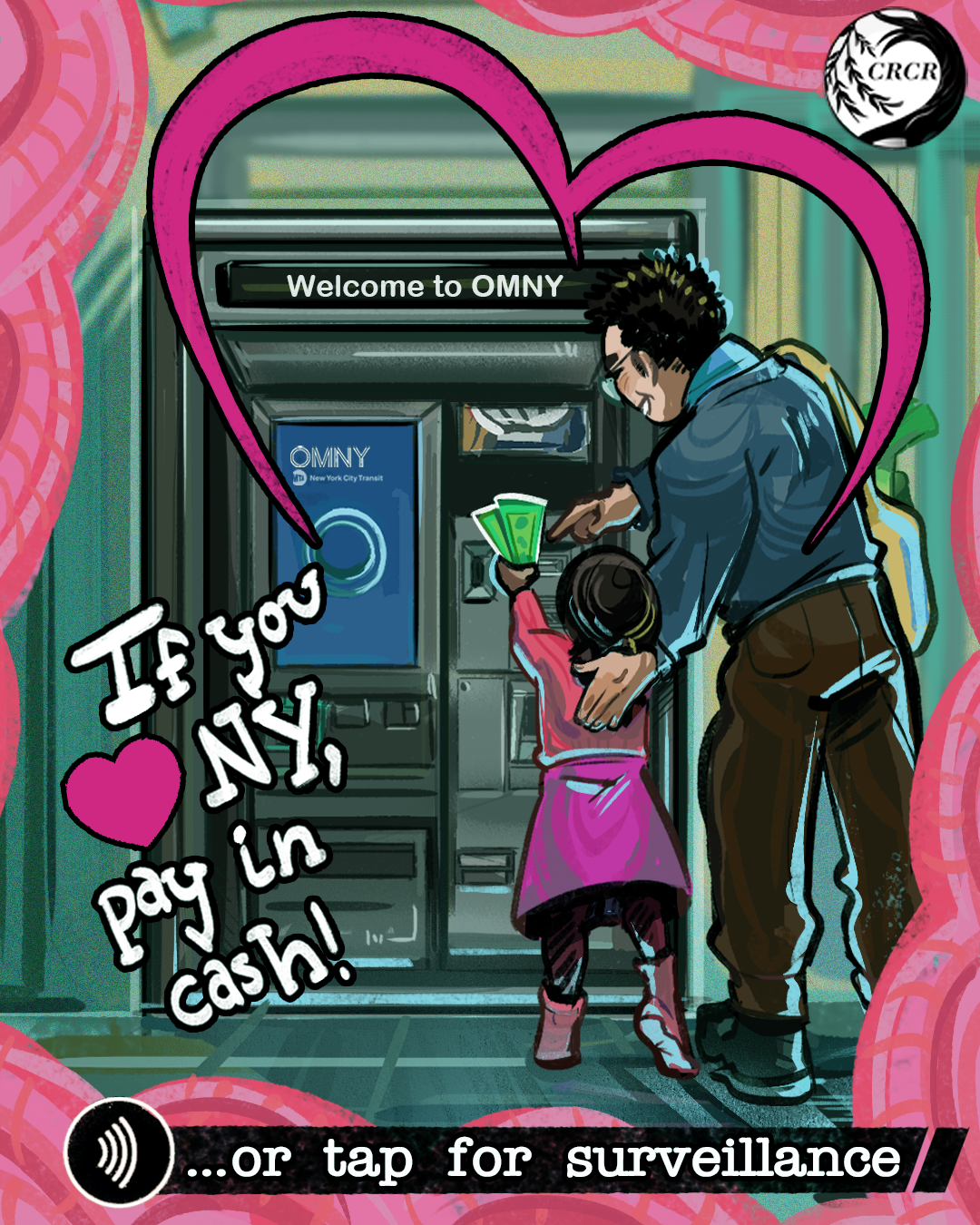
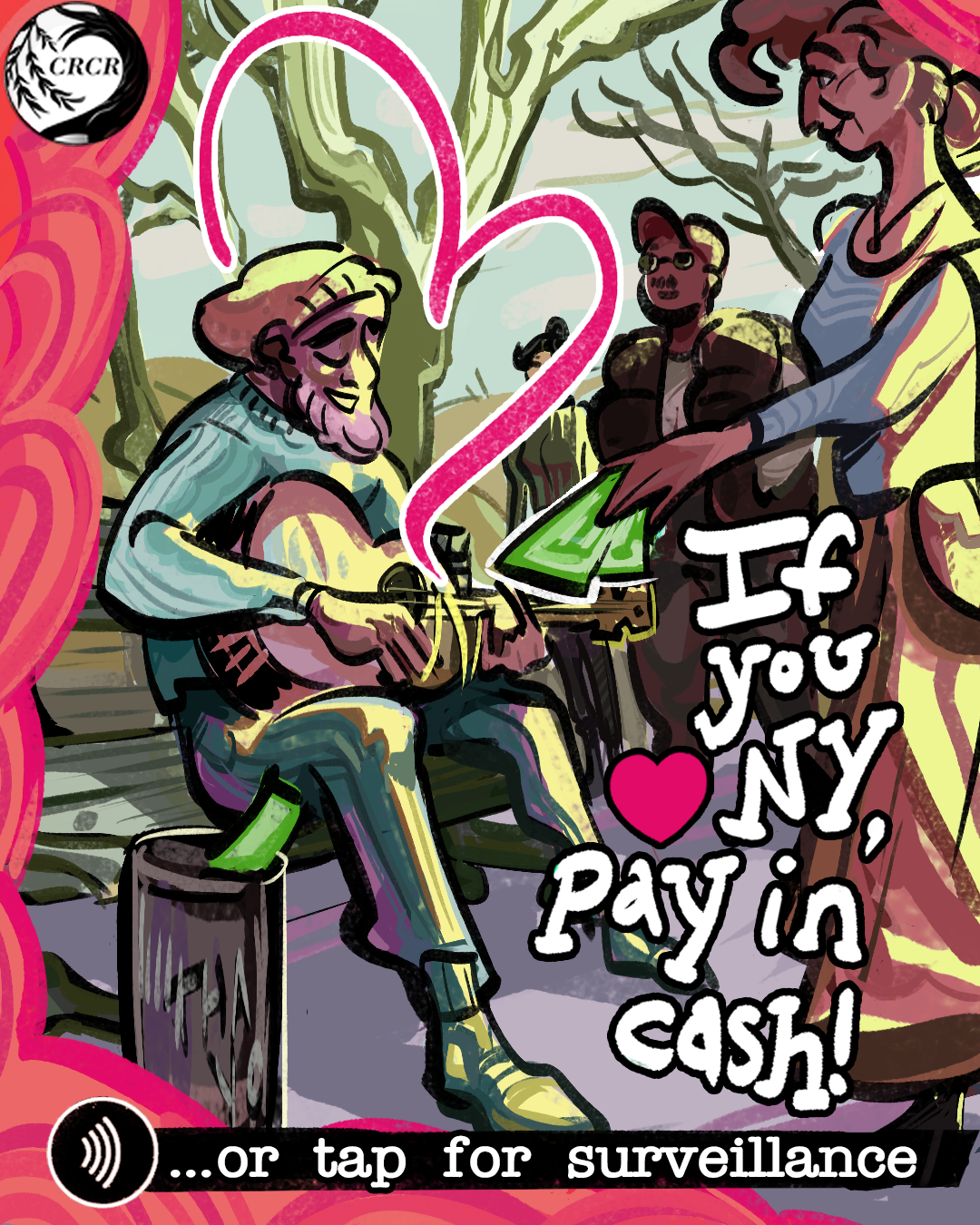
We wanted to love on our favorite city by highlighting a simple way we can all show love to our communities, street vendors, buskers, and struggling neighbors this Valentine’s.
So grab some dollars, aim your arrow, and pay in cash for a day. Or two. Or maybe forever? 😍
Why?
We know you know that when you tap with your phone into the subway, tap for lunch from your favorite street vendor, or tap for your coffee thermos refill at your favorite bodega, each tap creates data about what you’re buying, who you are buying it from, when and where you’re buying it.
Banks, digital wallets, and digital financial services companies sell that tap-tap-tap transaction data to brokers.Brokers package our data for sale to an array of industries, landlords, corporations, commercial advertisers, legal investigators, journalists, or to any paying customer. Federal, state, and local police also commonly purchase this data, even though it is a blatant constitutional violation for the state to seize our information.
Cards talk, whether they are OMNY, EBT, credit or debit cards. Cash keeps your community’s business (literally) in your community. It is a simple way to show love for your community every day.
Start small. Is there one small business, bodega, busker or street vendor you can pay in cash? Can you commit to using cash-only for all your favorite spots on your block? To grabbing a few singles when you walk out the door?
Make it cute. Meet somebody new. If someone rushes you along, give them your best Dustin Hoffman Midnight Cowboy impression and yell, “Hey, I’m paying cash here”.
Contribute! We would love to hear from you. How does using cash make you feel more connected to your community? Did using cash start a new convo? Did you get a discount you want to shout out? Please email us at [email protected], love letters and poems about pennies invited. There’s no wrong answers, we are also humans who live here and feel the same pressure to walk fast, talk fast, tap to pay fast. We invite you to explore the meet-cutes, the pain-points, and everything in between.
To learn more, follow this page. Below is a preview of our upcoming report and links to learn more.
This spring, Convocation Research + Design and the Collaborative Research Center for Resilience will be releasing a new report: Cash as Community Care vs Dark Patterns in Digital Wallets and Digital Financial Services.
We will cover some basics about digital wallets, digital financial services platforms, and will also explore cash in our communities from the policy level. We ask how can our city laws, regulations, and agency practices center community cohesion, connection, and power when deciding how to distribute benefits or protecting NYers’ ability to pay with and access cash free of penalties? How can our policies protect us from surveillance pricing and policing rather than expose us?
Here’s a preview:
In the computer design world, there is an idiom: a bug is a feature until it’s fixed. Bugs are ‘mistakes’ that harm users. We might immediately imagine an app crashing as a “bug” but features like nudging users to more expensive options are also bugs because they create a user experience that hurts vulnerable consumers. Both individual consumers and government purchasers must understand how each type of financial system works and potentially exposes our personal and community to surveillance.
Some basics: Digital wallets, digital financial service platforms, and cryptocurrency wallets
Digital wallets and digital financial services are legally required to prove and verify customers’ identities and transactions under “know your customer” or “KYC” laws. KYC are ways for financial services and banks to verify customers and their transactions. These laws were passed to track fraud, terrorism, and money laundering. As a result, the infrastructure for transaction tracking is applied to all transactions, even small transactions for daily sundries.
A digital wallet often sits on the phone or device and holds payment information, like credit cards or debit cards, making it easier for payment. Digital wallets, like credit and debit cards, do keep track of where you’re shopping, when, and what you buy (because of KYC and protecting their users against fraud).
Digital financial service platforms are companies and platforms that have a wide encompassing of services, and can differ from company to company or specific platform to platform. They can include digital wallets, digital payment methods, and digital services like investment, loans, insurance and other services related to finance. It’s important to remember that anything digital is keeping a very specific log of your interactions, and digital financial service platforms are no different, especially digital financial service platforms that include wallets, debit cards, and ways to buy and trade stocks, etc. All of that data is stored and tracked.
Digital financial service platforms include companies like Chime, MoCaFi, Nerdwallet and others; each of these companies include a myriad of activities and services. Some companies, like Chime, offer debit cards, mobile banking, the ability to build credit through their services, and the potential to get a Chime Visa credit card, but in Chime’s fine print on their website, they disclose they are not an FDIC insured bank, but a financial technology company. Nerdwallet, conversely, offers more services and features than Chime, but is also not an FDIC insured bank either. Digital financial service platforms, including neo banks, often sign agreements with FDIC insured partner banks for digital service platforms to borrow the coverage and services of that partner bank. Neo banks are digital first and digital only financial apps that often provide minimal services like a debit card, a checking account and some financial planning functionality in their apps.
Cryptocurrency wallets are entities that hold cryptocurrency assets and portfolios, and while they do hold assets similar to a digital wallet, it is a specific wallet designed just for cryptocurrencies. Cryptocurrency, like digital wallets generally, are tracking all the changes a consumer makes in that wallet, from sending cryptocurrency to other users, buying new crypto, and exchanging that crypto for fiat currency. But unlike digital wallets and digital financial services, KYC laws do not apply to cryptocurrency wallets in most jurisdictions.
Learn More:
- Read our report on how we protected NYC’s municipal IDNYC from an attempt to merge it financial technologies Smart City and Digital ID Projects (December 2021)
- Read CRCR Demands for Protecting Human Dignity and Choice from Digital ID Systems
- Read By Design? How Design Harms and Confuses Consumers in Digital, Finance Products by Caroline Sinders, co-founder of Convocation Research + Design published October 12, 2025
- Listen to the “No Cash, Big Problem: How Tap-to-Pay’s Ubiquity is Hurting New Yorkers” episode of the Brian Lehrer Show (December 2025)
- Read Anna Kodé’s article A Tap-to-Pay Society Is Leaving These New Yorkers Behind.
We ❤️ you NYC. Spread love!